Software Engineer
Can AI replace software engineers? At 50% risk, coding is changing fast. The engineers who win will ship products, not just features — and use AI to do it.
AI is writing more code than ever, but someone still needs to know what code to write. The engineers who win will ship products, not just features.
Can Robots Take My Software Engineering Job?
You're here because you've seen AI write code that actually works, and you wondered if that CS degree was about to become very expensive wallpaper. Here's what's actually happening.
We've Been Here Before: Outsourcing Didn't End Software Engineering
In the 2000s, offshore outsourcing was going to eliminate American software jobs. Then no-code platforms. Then bootcamp graduates flooding the market.
Software engineering salaries have grown faster than almost any profession over the same period.
Why? Because companies don't pay for code. They pay for:
- Understanding what problem to solve
- Translating business needs into technical solutions
- Making architectural decisions that scale
- Debugging the unforeseen edge cases
- Knowing when NOT to build something
- Owning outcomes, not just outputs
AI can generate a function. It can't decide if that function should exist.
What AI Can Actually Do Today
Tasks AI Wins At:
- Boilerplate code - CRUD operations, standard patterns (90%+ faster)
- Code completion - Autocomplete on steroids
- Test generation - Unit tests from existing code
- Documentation - README files, inline comments
- Bug fixes - Simple, well-defined issues
What Humans Still Dominate:
- Architecture - System design that scales and evolves
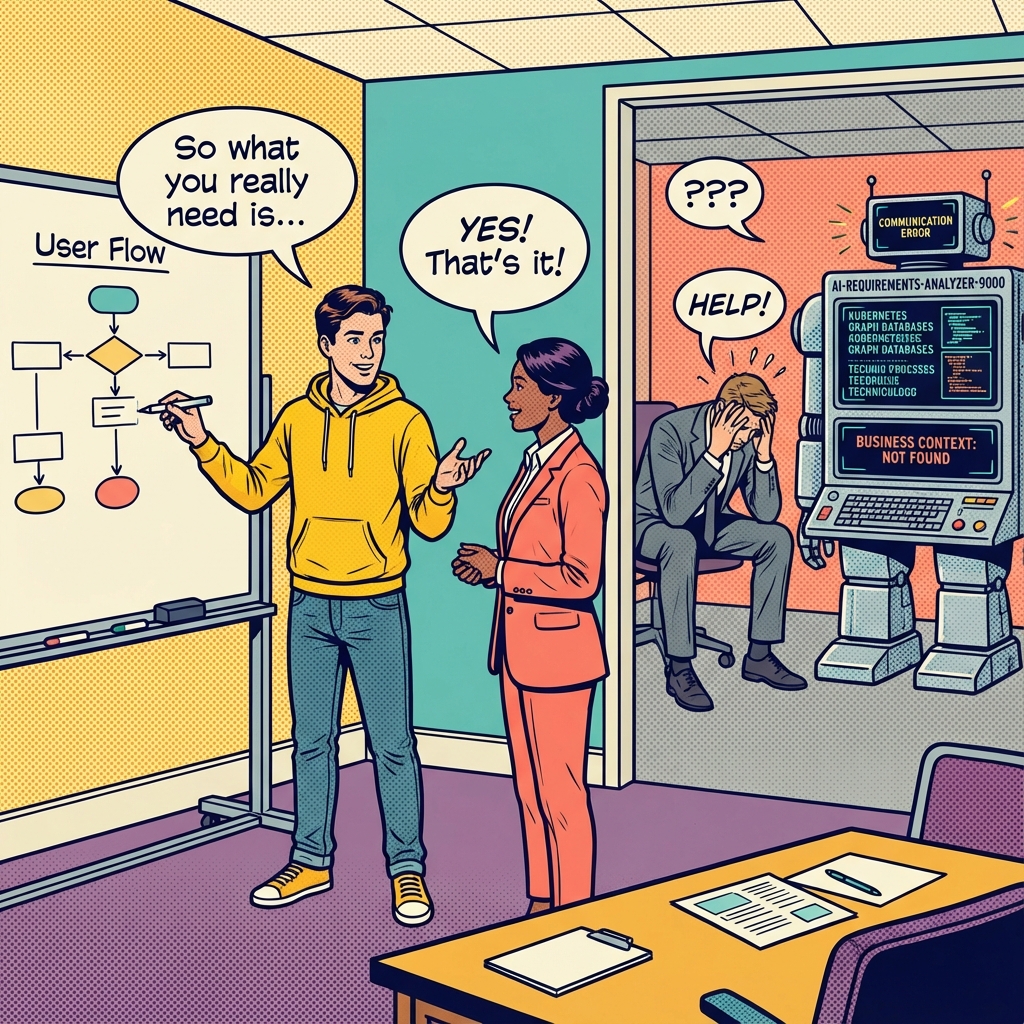
- Requirements - Understanding what users actually need
- Debugging - Complex, multi-system issues
- Code review - Catching security issues, maintainability problems
- Stakeholder communication - Translating tech to business
- Decision-making - Build vs buy, prioritization, trade-offs
The Tasks Table: Robot vs Human
| Task | AI Capability | Human Advantage | Winner |
|---|---|---|---|
| Boilerplate code | 90% | 10% - context awareness | AI |
| Code completion | 85% | 15% - judgment on suggestions | AI |
| Unit test generation | 75% | 25% - testing strategy | AI |
| Simple bug fixes | 70% | 30% - root cause analysis | Tie |
| System architecture | 20% | 80% - business context | Human |
| Requirements gathering | 15% | 85% - stakeholder relationships | Human |
| Complex debugging | 25% | 75% - intuition + experience | Human |
| Code review | 40% | 60% - security, maintainability | Human |
| Technical leadership | 10% | 90% - people + strategy | Human |
Risk by Project Type: Not All Developer Work Is Equal
The "50% automation risk" above is an average. Your actual risk depends heavily on what kind of work you do. As of late 2025:
| Project Type | AI Displacement Risk | Timeline | Why |
|---|---|---|---|
| Landing pages | 80-90% | Now | Fully commoditized by AI tools |
| Internal tools / MVPs | 60-70% | Now | "Good enough" is acceptable |
| Consumer apps (basic) | 50-60% | 1-2 years | Scale/security issues eventually surface |
| Enterprise systems | 30-40% | 3-5 years | Compliance, security, integration complexity |
| Security-critical systems | 10-20% | 5+ years | AI currently creates vulnerabilities, doesn't fix them |
| Legacy system maintenance | 15-25% | 5+ years | Context and judgment required |
Key insight: The same project can move between categories. A "simple internal tool" that succeeds becomes an "enterprise system" that needs real engineering.
The Cleanup Economy Opportunity
Here's what's emerging: every vibe-coded MVP that succeeds eventually needs professional help. Non-developers are building apps with ChatGPT, Cursor, and Replit—and many of those apps will hit walls:
- Performance issues when traffic grows
- Security vulnerabilities that get exploited
- Scaling problems when users multiply
- Edge cases that break core functionality
The opportunity: Position yourself for rescue and cleanup work. Clients who've tried to DIY and hit walls come back with a NEW appreciation for professional expertise—and urgency that commands premium rates.
This may change as AI capabilities improve. But right now, there's a growing inventory of vibe-coded production apps with ticking time bombs in their codebases.
The Hidden Cost: Cognitive Debt
There's a catch to all this AI-generated speed. Computer science professor Margaret-Anne Storey coined the term cognitive debt in early 2026 to describe what's happening: AI makes teams 55% faster at writing code, but incidents on AI-written modules take 3-4x longer to resolve (Storey, 2026). The code works — until it doesn't, and nobody understands how it works.
Three numbers tell the story:
- 55% faster: GitHub Copilot's verified impact on code generation speed
- 29% trust: Only 29% of developers trust AI-generated code (Stack Overflow 2025 Developer Survey, down from 40% in 2024)
- 3-4x longer: Mean incident resolution time on AI-written modules vs human-written modules
Why this matters for your career: The engineers who can understand, explain, and debug AI-generated code are becoming more valuable, not less. If your team needs AI to explain its own codebase, understanding has become the scarce skill — and scarcity drives salaries up.
The Counter-Narrative: AI Creates More Software Work
Here's the surprising reality:
More code than ever is being written More products than ever are being shipped More problems than ever need software solutions
AI isn't replacing engineers—it's expanding what's possible.
The Headlines vs The Data
Before you panic: Oxford Economics found that only 7% of US layoffs in January 2026 actually cited AI as the reason (7,600 of 108,435 total). Even OpenAI's Sam Altman acknowledged at the India AI Summit in February 2026 that companies sometimes use AI as layoff narrative cover for financially-driven cuts.
Meanwhile, IBM announced in February 2026 that it's tripling entry-level developer hiring — the clearest counter-signal to the "AI eliminates junior developers" narrative. Their reasoning: eliminating junior roles creates a 3-5 year talent gap that costs more to fix later than it saves now (Bloomberg, February 2026).
The junior roles are changing, not vanishing. IBM is redeploying juniors toward client-facing work — translating requirements, explaining AI outputs, bridging the gap between strategy people and AI builders. Less boilerplate coding, more communication and judgment.
The Team Productivity Paradox
Here's the counterintuitive data: Teams using AI tools saw sprint velocity jump from 60% to 85%—but the improvement didn't come from faster coding. It came from:
- Clearer requirements (50% reduction in bug clarification time)
- Faster PR reviews (20% reduction in review cycle time)
- Better work allocation (50% less management overhead)
The bottleneck shifted from "writing code" to "defining what to build." AI makes individuals faster; better coordination systems make teams faster.
The real transformation:
- AI handles the typing, humans handle the thinking
- Faster prototyping means more experiments
- Lower cost of MVPs means more products get built
- Engineers become product-oriented, not code-oriented
The Solo Developer Multiplier
As of March 2026, autonomous AI agent systems have crossed a threshold that changes the math for individual engineers. Factory AI's Missions product — backed by $70M from NEA, Sequoia, and Nvidia — lets a single developer deploy AI agents that build software autonomously for days at a time. The numbers:
- One developer built a full real-time Slack clone using autonomous agents
- A 76-feature club management app (auth, scheduling, group management) built via a single mission specification
- Factory reports missions running autonomously for up to 16 days, with 14% exceeding 24 hours
For experienced engineers with domain expertise and evaluation skill, this is profoundly positive. A senior developer who can specify precisely, review agent output, and course-correct is now a one-person product team. The solo/indie developer path — once limited to simple projects — now encompasses production-grade applications.
The flip side: development agencies and small consultancies face pressure. If a solo developer ships a 76-feature app in 48 hours, the economics of a 3-5 person team for similar scope get harder to justify. The agency's value shifts from "we build it" to "we ensure the right thing gets built correctly."
The career window: Right now (Q1-Q2 2026), autonomous agent fluency is a differentiator. By late 2027, it'll be the baseline. The engineers who learn to specify, evaluate, and direct agent output now get a head start. Those who wait will find the advantage has normalized.
The Bottom Line
Yes, AI will write more and more code automatically. No, AI won't replace the engineer who understands what to build and why.
The engineers who thrive will be:
- AI-augmented (using tools to ship 3x faster)
- Product-minded (solving problems, not just writing code)
- Architecture-focused (designing systems, not just features)
- Business-aware (understanding the "why" behind the "what")
Your move: Start using AI coding tools this week. The engineers who struggle won't be replaced by AI—they'll be outperformed by engineers who use AI to think bigger.
What's Next?
Ready to future-proof your career? Our AI Adaptation Guide covers the skills and strategies that matter across every profession—from embracing AI tools to doubling down on uniquely human strengths.
Latest on software engineering and AI:
- Geoffrey Hinton's 2026 Prediction — The "godfather of AI" says coding tools will handle months-long projects in a few years. We assess his track record.
- UK AI Job Market: 8 Million Exposed — King's College data shows AI-exposed firms already cutting jobs.