Graphic Designer
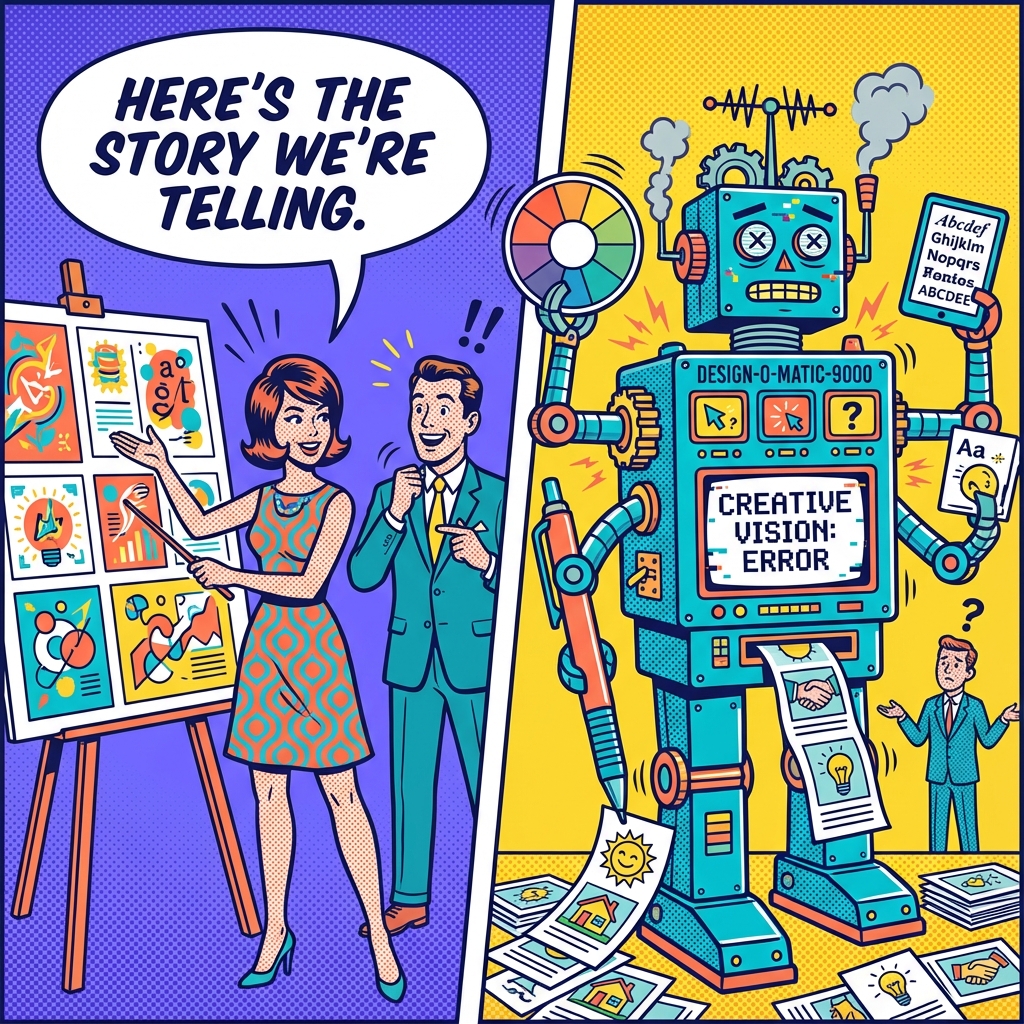
Can AI replace graphic designers? At 65% risk, production work is vulnerable. But understanding why a brand needs to feel 'trustworthy but not boring'? Still human.
AI can generate images faster than you can open Photoshop, but it can't understand why a client's brand needs to feel 'trustworthy but not boring.' The designers who win will be creative directors, not pixel pushers.
Can Robots Take My Design Job?
You're here because you've seen DALL-E and Midjourney create stunning images in seconds, and you wondered if your design career was over before it started. Here's what's actually happening.
We've Been Here Before: Canva Didn't Kill Design
In the 2010s, Canva was going to let everyone be a designer. Then stock photo sites. Then template marketplaces. Then Fiverr with $5 logos.
Design agency revenue has grown every year, and senior designers are more valuable than ever.
Why? Because clients don't pay for pixels. They pay for:
- Understanding their brand story and target audience
- Strategic thinking about visual communication
- Knowing why one design "feels right" and another doesn't
- Translating business goals into visual language
- Consistency across touchpoints
- Someone to push back when their ideas are bad
AI can generate 100 logo options. It can't tell you which one captures your company's soul.
What AI Can Actually Do Today
Tasks AI Wins At:
- Image generation - Creating visuals from text prompts (stunning quality)
- Background removal - Instant, perfect every time
- Resizing/reformatting - Automatic adaptation to different sizes
- Color palette generation - Instant mood-matching palettes
- Stock asset creation - Custom illustrations on demand
What Humans Still Dominate:
- Brand strategy - Understanding what a brand needs to communicate
- Client relationships - Interpreting vague feedback into actionable direction
- Creative direction - Knowing what to ask AI for and what to reject
- Consistency - Maintaining brand coherence across campaigns
- Conceptual thinking - The big idea that ties everything together
- Quality control - Catching AI's weird fingers and nonsense text
The Tasks Table: Robot vs Human
| Task | AI Capability | Human Advantage | Winner |
|---|---|---|---|
| Image generation | 85% | 15% - knowing what to generate | AI |
| Background removal | 95% | 5% - edge cases | AI |
| Asset resizing | 90% | 10% - quality decisions | AI |
| Color selection | 70% | 30% - brand context | Tie |
| Layout design | 60% | 40% - hierarchy decisions | Tie |
| Brand strategy | 15% | 85% - business understanding | Human |
| Client communication | 10% | 90% - relationship + translation | Human |
| Creative direction | 20% | 80% - vision + judgment | Human |
| Concept development | 25% | 75% - originality + meaning | Human |
The Emerging Escape Route: Design Engineering
Here's something most designers don't know yet: AI isn't just threatening the design role — it's creating a new one.
The design engineer is a hybrid role bridging design and engineering — the exact gap "where quality goes to die." Design engineers operate fluently in both code and design, prototyping, specifying, and implementing without the traditional handoff stage.
Why it's growing now:
- AI slop proliferation makes quality a differentiator — someone must apply human taste
- AI tools enable crossover — designers can now code via Claude and Cursor, engineers can now design
- The handoff gap costs more as shipping speed increases
Raphael Salaja, a design engineer at Warp, predicts: "In a few years, most teams will be composed largely of design engineers working with AI tools" (Salaja, 2026).
How to get there from graphic design:
- Use AI coding assistants to turn your Figma designs into working components
- Over time, start visualizing the HTML/React behind your Figma frames
- Follow the Study-Notice-Build framework — study the best work, notice inconsistencies, build by customizing
This isn't about becoming a full-stack developer. It's about being the person who ensures the final product actually looks and feels right — something AI consistently fails at.
The Counter-Narrative: AI Makes Design 10x More Valuable
Here's the surprising reality:
More visual content is needed than ever (social media, personalization) Faster turnaround is expected by everyone Personalization at scale is now possible
AI isn't replacing designers—it's making design economically viable for everything.
The real transformation:
- AI handles execution, humans handle strategy
- One designer can now do the work of a whole team
- Small businesses can finally afford real design
- Designers become creative directors faster
Taste as Career Insurance
Here's a number that should make designers feel better: in a 2026 study testing AI against professionals across 1,320 tasks in 44 occupations, AI matched 14-year veterans at about 70% quality (GDPVal, 2026). That other 30%? It's taste — knowing what to reject, what needs one more iteration, what "almost right" actually means.
As AI floods the market with "good enough" visuals, the ability to distinguish good from great becomes rarer and more valuable. The designers who develop this judgment — through years of looking at work, studying what works, and building an instinct for quality — are the ones AI can't replace.
The Bottom Line
Yes, AI will automate image generation and production work. No, AI won't replace the designer who understands why a brand needs to feel a certain way.
The designers who thrive will be:
- AI-augmented (using tools to execute 10x faster)
- Strategy-focused (selling thinking, not pixels)
- Relationship-driven (clients pay for understanding)
- Quality-obsessed (knowing what to accept and what to reject)
- Hybrid-ready (exploring the design engineer path)
Your move: Generate 20 images with Midjourney today — then practice rejecting the ones that are almost right. The designers who struggle won't be replaced by AI—they'll be outcompeted by designers who develop the taste to know what AI gets wrong.
What's Next?
Ready to future-proof your career? Our AI Adaptation Guide covers the skills and strategies that matter across every profession—from embracing AI tools to doubling down on uniquely human strengths.