
Financial Analyst
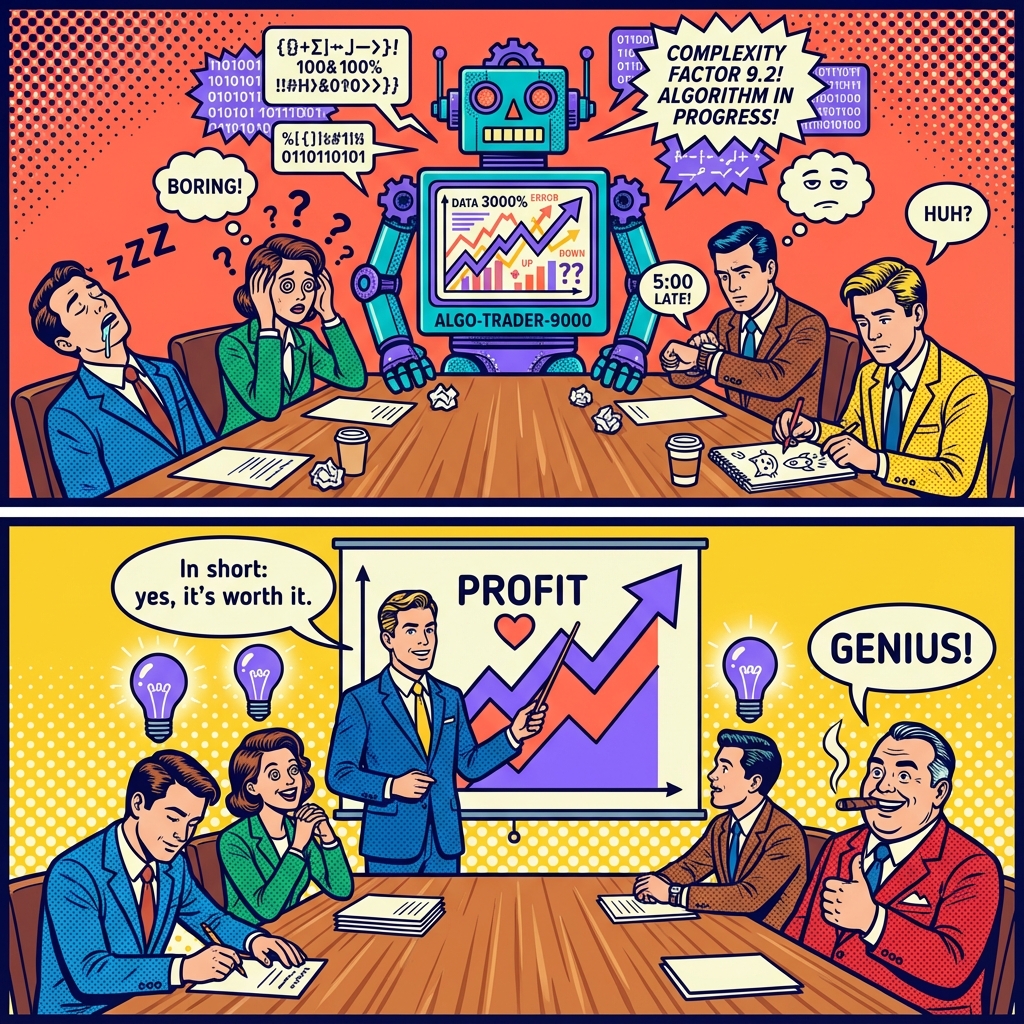
Can AI replace financial analysts? At 50% risk, data processing is automating. But the analyst who explains to a nervous CEO what it all means? Still essential.
AI can crunch numbers faster than any human, but it can't sit across from a nervous CEO and explain why the numbers mean they should make a hard decision. The analysts who win will be translators, not calculators.
Can Robots Take My Financial Analyst Job?
You're here because you've seen AI generate financial models and market analysis, and you wondered if your Excel skills were about to become worthless. Here's what's actually happening.
We've Been Here Before: Excel Didn't Kill Finance
In the 1980s, spreadsheets were going to eliminate financial analysts. Then Bloomberg terminals. Then algorithmic trading. Then robo-advisors.
Financial analyst employment has grown steadily, and compensation keeps rising.
Why? Because clients don't pay for numbers. They pay for:
- Explaining what the data actually means
- Judgment calls on incomplete information
- Knowing which questions to ask
- Relationship and trust over time
- Defending recommendations to skeptical stakeholders
- Someone to call when the market goes crazy
AI can build a DCF model. It can't convince a board to approve a difficult acquisition.
What AI Can Actually Do Today
Tasks AI Wins At:
- Data aggregation - Pulling from multiple sources instantly
- Financial modeling - Building standard models from templates
- Market screening - Filtering stocks by criteria
- Report generation - First drafts of standard analyses
- Pattern recognition - Identifying trends in historical data
What Humans Still Dominate:
- Strategic interpretation - What the numbers mean for THIS client
- Client relationships - Trust built over years
- Stakeholder communication - Presenting to executives and boards
- Judgment under uncertainty - Making calls when data is incomplete
- Creative problem-solving - Structuring novel deals
- Market context - Understanding what the news really means
The Tasks Table: Robot vs Human
| Task | AI Capability | Human Advantage | Winner |
|---|---|---|---|
| Data gathering | 95% | 5% - knowing what to look for | AI |
| Standard modeling | 85% | 15% - assumption judgment | AI |
| Market screening | 90% | 10% - qualitative factors | AI |
| Report drafting | 70% | 30% - narrative + insight | Tie |
| Valuation analysis | 60% | 40% - judgment calls | Tie |
| Strategic recommendations | 25% | 75% - context + relationships | Human |
| Client presentations | 15% | 85% - persuasion + credibility | Human |
| Deal structuring | 20% | 80% - creativity + negotiation | Human |
| Board advisory | 10% | 90% - trust + judgment | Human |
The Counter-Narrative: AI Makes Analysts More Valuable, Not Less
Here's the surprising reality:
More data exists than ever (someone needs to make sense of it) Faster markets require faster human decisions Complex deals still need human structuring Clients still want humans they trust
AI isn't replacing analysts—it's giving them superpowers.
The real transformation:
- AI handles data processing, humans handle insight
- Junior analyst tasks are accelerating, not disappearing
- More time for client relationships and strategy
- Higher expectations for speed AND quality
Don't Judge AI by ChatGPT Alone (March 2026 Update)
A critical warning for analysts who've tried AI and found it "not good enough": multi-agent architectures — where specialized AI agents collaborate on complex tasks — are now solving research-grade problems that single AI interactions couldn't touch. Four major AI labs converged on the same approach in early 2026 (Anthropic, Google DeepMind, OpenAI, Cursor).
Financial analysis is classified as Tier 2 verifiable work — meaning senior analysts can evaluate AI output quality with reasonable consensus. That makes finance a prime candidate for the next wave of structured AI systems. When multi-agent financial tools arrive (expect 2026-2027), they won't just pull data — they'll build models, run scenarios, and draft analyses.
The career implication: Your value isn't "AI can't build good models." It's "can I review an AI-built model and catch the assumption that doesn't match market reality?" The analysts who can sniff-check AI output with domain authority will be force-multiplied. Those who can't will be competing with tools that work 24/7.
The Bottom Line
Yes, AI will automate data gathering and standard financial models. No, AI won't replace the analyst who looks a CEO in the eye and says "Here's what you should do and why."
The analysts who thrive will be:
- AI-augmented (using tools to analyze 10x faster)
- Advisory-focused (selling judgment, not spreadsheets)
- Relationship-driven (clients pay for trust)
- Specialized (deep expertise in complex areas)
Your move: Use AI to build your next model in half the time. The analysts who struggle won't be replaced by AI—they'll be outperformed by analysts who use AI to think bigger.
What's Next?
Ready to future-proof your career? Our AI Adaptation Guide covers the skills and strategies that matter across every profession—from embracing AI tools to doubling down on uniquely human strengths.